For Academia
Teach difficult texts without simplifying them.
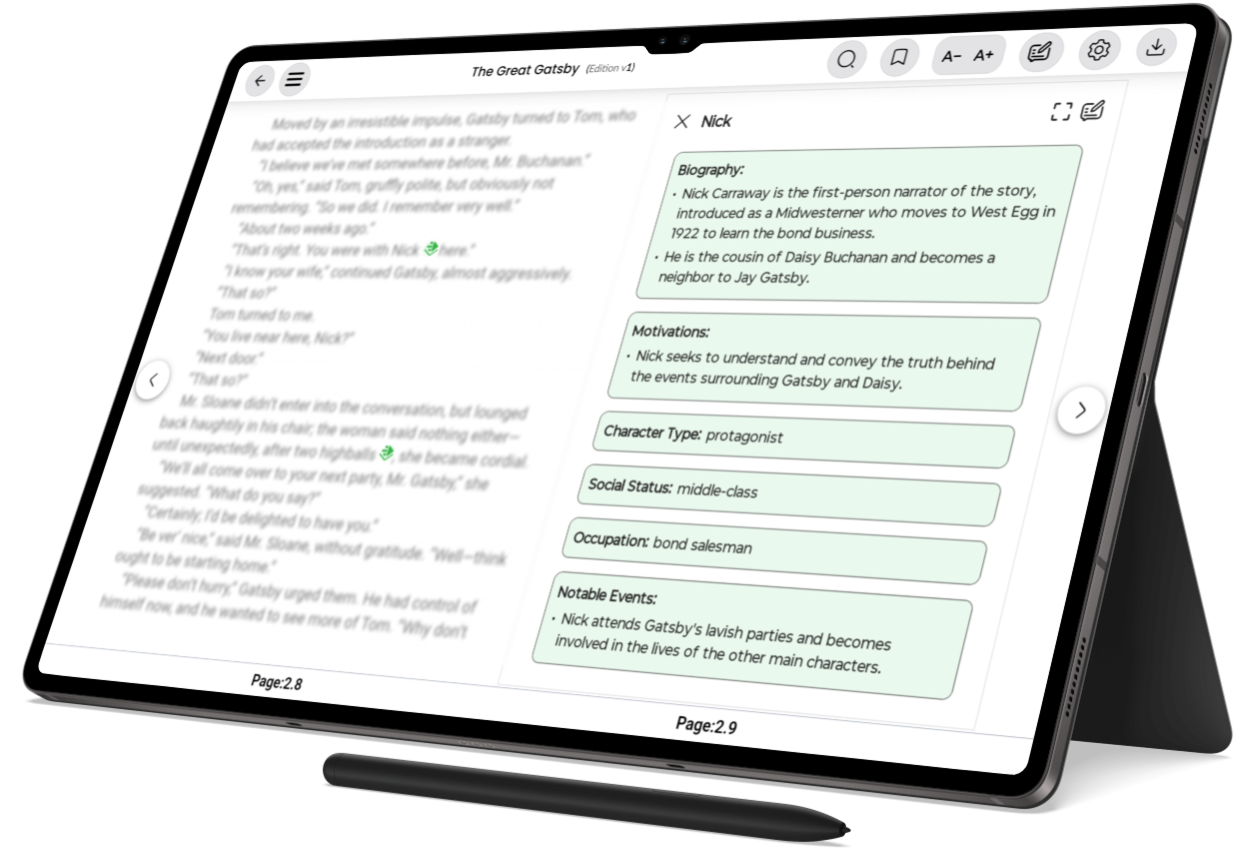
Visualible helps students stay oriented in complex, context-dense works while reading the original text itself. It is designed for courses where students lose the thread because of names, places, references, history, terminology, or accumulated context — not because the text should be simplified.
Academic trust principles
Original text preserved
Students read the original work exactly as assigned. Visualible does not rewrite, abridge, modernize, or simplify the text.
Support stays optional
Students open context only when they need it. Support appears separately and does not interrupt the reading flow.
Use where difficulty is real
Best for texts where background knowledge gaps, reference density, unfamiliar names, places, or accumulated context slow reading.
How Visualible supports reading
Visualible is most useful at the moment of disorientation: when a student recognizes that a person, place, term, event, or concept matters, but lacks enough context to continue confidently.
Read the original work
The assigned text remains central. Students continue through the work itself, not a paraphrase or summary.
Open context when needed
Support can clarify people, places, terms, events, historical background, and concepts at relevant moments.
Return to the text
Students close the support and continue reading without leaving the page or losing their place.
Where this works best
Best-fit texts
Great Books and classic works
Historically situated works
Context-heavy literary texts
Philosophy, history, religion, political theory, and humanities texts
Works with many people, places, events, terms, or references
Best-fit academic settings
Undergraduate literature courses
Great Books programs
Humanities seminars
Core curriculum / general education courses
Faculty pilots and instructional experiments
Start with one course and one difficult text.
Visualible pilots are designed to be narrow, low-friction, and easy to evaluate. Students read the original work, use optional context when needed, and return to the text without leaving the page.
When Visualible is a good fit
Courses where students struggle to stay oriented
- Texts with heavy reference density
- Assignments where reading continuity matters
- Courses where instructors do not want to simplify the text
When it's likely not needed
- Introductory texts designed for accessibility
- Courses where interpretation, not comprehension, is the primary challenge
- Works where existing notes or annotations are already sufficient
What Visualible does not do
- Visualible does not alter, rewrite, abridge, modernize, or simplify the original text.
- Visualible does not replace reading with summary.
- Visualible does not act as a shortcut around the assigned work.
- Visualible does not diminish the role of the instructor, classroom discussion, or scholarly interpretation.
- Visualible does not remove difficulty from serious works; it helps students stay oriented within that difficulty.
Visualible is meant to support reading, not bypass it. Its academic value depends on respecting the integrity of the work and the seriousness of the classroom.
Frequently asked questions
No. Visualible is not designed to replace the assigned work with summaries or shortcuts. It helps students regain context so they can continue reading the work itself.
A low-friction academic pilot
A pilot can begin with one course, one instructor, and one or two assigned texts. Visualible can be evaluated on whether students stay oriented, reduce off-page searching, and continue reading the assigned work more confidently.
One course or reading group
One or two texts
Fixed MeBook editions
Optional student feedback
Instructor review before broader use
No long-term commitment
Start an academic conversation
Visualible is interested in speaking with instructors, programs, and academic partners who teach difficult, context-dense works and want to explore whether a supplemental reading layer can help students stay oriented in the text itself.
A pilot can begin with one course and one or two texts. Initial conversations are exploratory and non-binding.
Use the form below to start a conversation.
Explore whether Visualible fits your course
If your students struggle to stay oriented in difficult texts, we can explore a conversation about fit.